September 18, 2013

Looking for Lincoln's Gettysburg Address

Cornell University, The White House, the Library of Congress, the Abraham Lincoln Presidential Library and Museum in Illinois ... they're all places that own original, authenticated copies of President Abraham Lincoln's Gettysburg Address. But Gettysburg is not one of them.

Pennsylvania state Sen. Robert Casey recently petitioned the Library of Congress to borrow one of the library's two copies of the Gettysburg Address so that it can be temporarily displayed in Gettysburg in time for the 150th anniversary of the Gettysburg Address on Dedication Day, November 19.

Citing fragility of the documents and their priceless nature, the Library of Congress declined, saying that a 1990 policy forbids the library from loaning out its irreplaceable documents, including the rough draft of Thomas Jefferson's Declaration of Independence and the Gettysburg Address.

What do you think? Should Gettysburg be granted a special exception given the significance of the anniversary or should Gettysburg look elsewhere? Post your comments here or on our Facebook page.

August 22, 2013

Talking Science Education with Dr. Ainissa Ramirez

By Kim Weaver

Dr. Ainissa Ramirez, a science evangelist and science lecturer, is passionate about getting kids of all ages excited about science. Ramirez shatters the science stereotype as a scholar, inventor and revolutionary innovator in her role as director and host of Yale’s “Science Saturdays,” an award-winning series fashioned to introduce children to scientists. Shes written Save Our Science (TED Conferences, 2013) and Newton’s Football (Ballantine Books, 2013).

Here’s a glimpse of our Q&A with Ramirez:

CG: What is science education?
AR: Science education is more than just the memorization of facts, as you and I might remember it to be. Memorized facts alone are not really useful in the 21st century when we have things like Google. Those facts are just a mouse click away. Science is the art of asking questions and figuring things out. To do that successfully, we need to nurture skills like creativity, encourage curiosity and give students opportunities to learn that failure is not something to be feared, but part of the process of learning and innovating. 
Currently, we are in an age of testing. I would dare say there is too much of it or rather we are undergoing a paralysis of analysis. I liken it to having a patient on a gurney and we are too busy getting all the data we can about them, instead of just treating the patient. 

All this testing is encouraging skills that are counter to what we need in the 21st century. Children are afraid to try new things because they are scared to be wrong; tests don’t drum up interest in a topic when all the passion has been replaced by anxiety to do well on exams, and tests do nothing to instill creativity. So the crisis does not lie solely in science information but in cultivating passion for learning. That is the biggest tragedy of all.  


CG: Why is it so important to you that young people feel passionate about science?
AR: I want young people to know about science because it is a tool to exercise the brain. In this age of big data, we need individuals that can ask questions and know how to make decisions based on the things they find. The scientific mindset is the key to being successful in the future. This gives children the ability to be makers and creators of the 21st century and not just consumers of it. A science mindset allows children to be more engaged in the world as citizens, too. They can see the issues that are at hand and, more importantly, science gives them the tools to solve them.

Another thing that science does is it gives kids a chance to be kids. While children may act like adults, they are still growing and many of the stages they need for human development are not being honed by tests. Science teaches children about patience, creativity, trial-and-error, persistence, asking questions and other important skills, all in the context of doing science. We learn in science that things don’t happen overnight (patience), things break and you need to try again (persistence and trial and error) and questions often lead to other questions (curiosity). Learning science makes us more human.


CG: Whatever happened to the science classes of 30, 40 years ago?
AR: I’ll tell you what a science class in the 1890s looked like. Girls were the majority, and in some classes, there were more girls than boys. This sounds like science fiction, but while researching my book called Save Our Science, I stumbled onto a book called What Happened to Our High Schools? by John Latimer, which had tables of science and math class enrollments. I was blown away to know that at one time girls were the majority and there was no discussion that girls could not do science.

So this begs the question: Who let the girls out of science classes? It was a combination of the home economics movement, the substitution of classics classes for science, which were needed for college admission and gender discrimination. Now, gender discrimination is an old and unwelcomed guest, but the other factors tell us that the reason why girls left science was based on a cultural mindset, not their ability. We need to let girls know they can do science and used to be in the majority.

As for under-represented groups, the numbers have been alarmingly low for decades. More recently, there has been a modest increase over the last few years, but it is no way close to the percentage represented in society. This is an untapped population. Society loses when everyone cannot participate. Imagine all the inventions, discoveries and companies that never happened because a part of the population never got a chance to make them. 


CG: You have said there is a crisis in science education. What do you say to those who believe differently?
AR: I would tell them to look at the back of their cell phone and tell me what country it was made in. Then, I would let them know that most of the innovation that originally created the cell phone came from the U.S., so we were ahead of the race, but in a very short time we are now lagging behind the pack.


CG: What do you hope to see in the future regarding science education in the schools?
AR: Long term, we need more than education reform; we need a revolution. We need subjects taught in an integrated way showing their complexity. We need children to get their hands dirty and learn by doing. We need to change how we teach, and what we teach to match what the 21st century holds. It is hard to predict the jobs of the 21st century; we do know we need creative and curious thinkers that look at the art of failure as part of the discovery process. 

Short term: To give children the opportunity to exercise these thinking muscles, we should rely on the opportunities outside of schools. Science museums, after-school programs and even spending a night at home with your kids taking things apart, gives children the opportunity to get their hands dirty and discover. I spell out in Save Our Science how everyone can help provide engaging science learning for all children. Science Outside Schools (SOS) will feed our kids what they need, and in turn, create a demand for engaging science classes. Just like diamond can be created from charcoal with outside pressure. Schools will become a diamond, too, with some outside help. That is my wish anyway.

Ainissa Ramirez (@blkgrlphd) | www.ainissaramirez.com

July 11, 2013

Gettysburg's 150th Anniversary Commemoration

\

In July of 2013, the fields of Gettysburg once again echoed with the sounds of battle in commemoration of the 150th anniversary.

As captured by photographers Mark Anderson, Noel Kline and Andrew Murdock.

July 9, 2013

Gala Orchestra Concert Commemorates Independence Day in Gettysburg

Gettysburg Chamber Orchestra Delivers Star-Spangled Performance

Story and photography by Casey Saylor

Lawn chairs and blankets dotted the grass July 4 as crowds gathered outside of Gettysburg College’s Penn Hall to help the Metta Ensemble and Gettysburg Chamber Orchestra celebrate our nation’s birthday. The patriotic, public concert began as the American flag was carried out by a small, marching ensemble to a drum and piccolo rendition of “Glory, Glory Hallelujah.” As the small ensemble held attention up front, the audience stood as the orchestra delivered a powerful “The Star-Spangled Banner.” Then, as the piping piccolos and beating drums faded away, Conductor Alexander Kahn took the microphone.

After the short introduction, the Gettysburg Chamber Orchestra dove into their first of the evening’s many patriotic pieces with “The Armed Forces Salute.” Following tradition and Kahn’s request, veterans and active members of the audience stood as their branch’s tune was played to receive their well-earned recognition from the audience. After the piece, Kahn turned to the microphone again, thanking all the men and women in the audience who served. As he spoke, however, a little girl of no more than 3 ran circles in front of the stage. Turning a bit red, Kahn ended his statements of appreciation with an embarrassed, “And I think my daughter should sit down please ….”

Gettysburg College President Janet Morgan Riggs tries her hand at conducting the Gettysburg Chamber Orchestra. 
After the Gettysburg Chamber Orchestra performance, there was a short intermission as director Norman Nunamaker and the Metta Ensemble transitioned to the stage. After a medley of marches, Nunamaker took the microphone and invited a very surprised Gettysburg College President Janet Morgan Riggs to the conductor’s platform. He quickly gave her a crash course in conducting, with the Ensemble repeating the first measures of the march as Riggs practiced. “The most important parts of conducting,” Nunamaker instructed, “are the beginning and the end … we’ve already covered the beginning, [so] the end will take care of itself!”

At this, Riggs smiled. “I hear [the orchestra already] know when to stop … so let’s give this a go!”

Needless to say, Riggs did a fine job conducting the march, and then retired back to her seat in the crowd as Nunamaker returned to the platform to finish the concert.


In all, Thursday evening’s Fourth of July Gala Orchestra Concert proved to be a fine night of good music, smiles and sunshine that successfully brought the crowd together to focus on one, unanimous notion: Happy Birthday America.

July 5, 2013

Sacred Trust Lecture Series Speakers Share Perspectives on Battle Anniversary

Story and photography by Casey Saylor

A late June, extremely warm weekend offered the first of many presenters to speak at the annual Sacred Trust lecture series. Sponsored by the Gettysburg Foundation, the nonprofit fundraising and management partner for the National Park Service at Gettysburg, the free event continues this Friday, Saturday and Sunday (July 5, 6 and 7), with a range of speakers and topics featured from approximately 9:30 a.m. to 5 p.m.

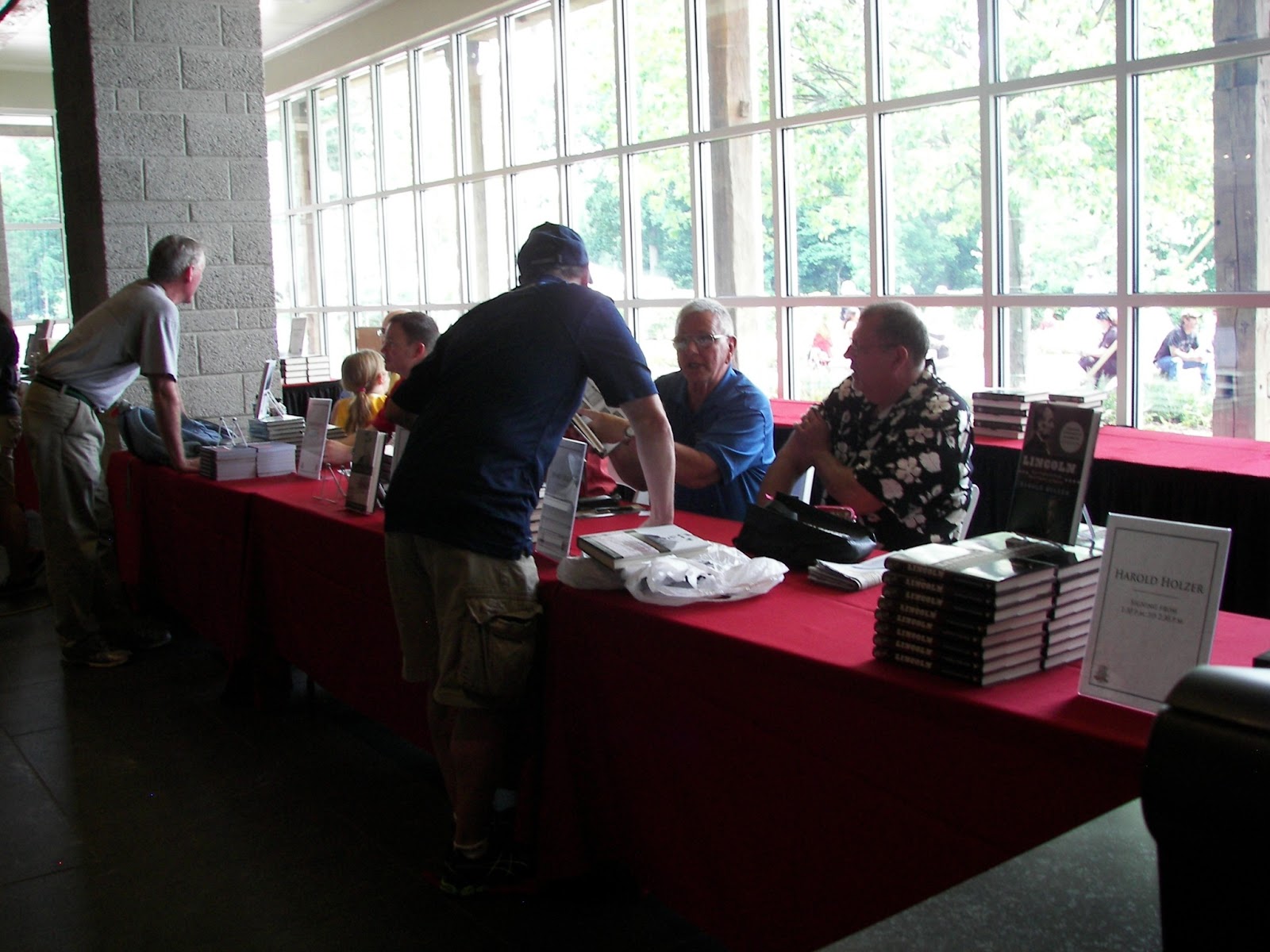
Harold Holzer
With lecture titles such as, “Gettysburg in 4D” and “General Lee’s Army and the Declining Margin for Error,” the first group of lectures from June 29 and 30 attracted crowds. On Sunday, June 30, author Harold Holzer’s presentation titled “Lincoln and Freedom in Film and Fact: A Look at History and the Movies, Spielberg and the Civil War” was limited to standing room only.

Author Howard Coffin’s presentation on “The Vermont Assault on Pickett’s Charge” offered a vivid depiction of the role of Vermonters in the Battle of Gettysburg. With vivid details, sound effects and motions, Coffin used his talents as a storyteller to illustrate the history of leadership in the Vermont Brigade, along with their battle tactics and outcomes against the Confederate soldiers. Occasionally, Coffin would include quotes and conversations in his stories of the brigades, changing his voice to add local color to the story while keeping the interest of the audience.


In addition to lectures, multiple book signings were taking place inside the lobby of the Museum and Visitor Center. Just like Holzer and Coffin, many of the lecturers participating in the program have written books, so directly after their talk, they move into the lobby to sign and sell their books. 

Below are some highlights from this weekend’s series of speakers. For the complete schedule, visit www.gettysburgfoundation.org.

Friday, July 5
  • Battlefields Are About Honor: Interpreting Slavery and Freedom at Gettysburg, 1863-2013 with Jennifer Murray: 1:30 p.m.
  • Gettysburg with Ed Bearss: 2:30 p.m.
  • The Gettysburg Story: America’s Greatest Battle as You’ve Never Seen It Before” with Jake Boritt: 3:30 p.m.
  • “The Gettysburg Address Reads Like American History” with Troy Harman: 4:30 p.m.
Saturday, July 6
  • 1913 Grand Blue-Gray Reunion at Gettysburg with Thomas Flagel: 10:30 a.m.
  • Civil War Filmmaking with Ron Maxwell: 3:30 p.m.
  • The Best and Worst Generals at Gettysburg with Bradley Gottfried: 4:30 p.m.
Sunday, July 7
  • Reunion and Commemoration with Sue Boardman: 11:30 a.m.
  • Despair, Defeat, Redemption and Determination-The Army of the Potomac in 1863 with Scott Hartwig: 1:30 p.m.
  • A.P. Hill at Gettysburg with Patrick Falci: 4:30 p.m.


Reenacting Pickett’s Charge – 150 Years Later

Story and photography by Brendan Raleigh

On a hot, humid July day, Old Glory and the Confederate battle flag fluttered gently in the wind as their respective carriers faced each other from a mile away. The roar of cannon fire pierced the air suddenly and the cries of Union soldiers shouting, “Fredericksburg! Fredericksburg!” could be heard from across the battlefield as the Confederate Army of reenactors advanced across the open field, just as the actual Confederate Army had 150 years ago under Maj. Gen. George Pickett.

Thousands gathered on the Gettysburg battlefield on Wednesday, July 3 to commemorate the 150th anniversary of Gen. George Pickett’s Charge, which many historians view as the most significant turning point of the Civil War. It not only dealt the Confederate Army a crushing defeat, ending Robert E. Lee’s Gettysburg Campaign, but it also dashed the South’s hopes of ever successfully invading the North.

The commemoration began as the Confederate reenactors emerged from the tree line to begin their fateful march across the fields. Nine National Park Service rangers led groups representing each of the Confederate brigades, and three rangers led three Union divisions stationed at Cemetery Ridge.

No rifle shots were fired during the march, as the commemoration served, not as an act of recreation, but one of deference and remembrance of the thousands who fell on the battlefield in 1863.

For some, such as U.S. Army veteran Tim Booker of Dolton, Illinois, the act of paying one’s respects to fallen warriors is a far more personal matter.

Tim Booker, Dolton, Illinois
“I fell in love with [Gettysburg] 16 years ago,” says Booker. “This is my fourth time coming here and I plan on coming here as much as I can. I’m here to honor the vets. I’m here to honor all of those who fought for freedom.”

Crowds of tourists, locals and members of the media lined up along what is known as “the high-water mark”—the farthest point at which Southern soldiers were able to advance—to witness the tribute, snapping pictures and cheering along with the Confederate soldiers as they issued their famous “rebel yell,” waving their hats and weapons proudly. From all across the country, people came to the battlefield to be a part of what one visitor from upstate New York called a “once-in-a-lifetime experience.”

After the soldiers completed their march, the crowd of onlookers and reenactors all bowed their heads in silence in deference as buglers and drummers played “Taps.” The scene evoked the haunting memory of those thousands of men who lost their lives that day.


Officials from the National Park Services estimates a total of approximately 35,000-40,000 people were at the Pickett’s Charge Commemorative March, including approximately 15,000 who crossed the fields. No serious injuries were reported.

An Independence Day Parade was previously scheduled for 7 p.m. that evening, but an emergency in the Gettysburg area demanded the police’s attention elsewhere, which resulted in the parade’s cancellation.

View more photographs from the Pickett's Charge Commemorative March on Celebrate Gettysburg's Facebook page.